Here's what's been up the last couple of weeks:
• March 2: a review of saxophonist Ralph Bowen's Power Play
• March 7: a review of Warriors and Cast the First Stone by hard bop revival group The Cookers
• March 8: a link to an excellent post on being a working musician, by trumpeter Jason Parker
• March 9: a review of Wynton Marsalis's Black Codes (From the Underground)
• March 11: a review of the Flow Trio (saxophonist Louie Belogenis, bassist Joe Morris and drummer Charles Downs) CD Set Theory: Live at the Stone
Showing posts with label joe morris. Show all posts
Showing posts with label joe morris. Show all posts
Friday, March 11, 2011
Friday, October 29, 2010
PULLED FROM THE FLAMES
I posted a bunch of stuff on Burning Ambulance this week. Here's the rundown:
Monday: review of Joe Morris's Camera
Tuesday: review of William Parker's Uncle Joe's Spirit House
Wednesday: interview with drummer Barry Altschul, by Hank Shteamer
Thursday: review of Many Arms' Missing Time
Friday: review of the Ornette Coleman Quartet's Reunion 1990
I hope you enjoy all this stuff, and I hope it'll convince you to buy issues of Burning Ambulance, the third of which will be coming out very soon.
Monday: review of Joe Morris's Camera
Tuesday: review of William Parker's Uncle Joe's Spirit House
Wednesday: interview with drummer Barry Altschul, by Hank Shteamer
Thursday: review of Many Arms' Missing Time
Friday: review of the Ornette Coleman Quartet's Reunion 1990
I hope you enjoy all this stuff, and I hope it'll convince you to buy issues of Burning Ambulance, the third of which will be coming out very soon.
Monday, October 25, 2010
BURNING AMBULANCE UPDATE
The Burning Ambulance blog is now BurningAmbulance.com. Stop by, won't you? (Issue #3 of the print edition is gonna be awesome, and it's coming sooner than you think, which makes now a perfect time to buy #s 1 and 2, if you haven't already.) Fresh content up today, too: a review of Joe Morris's new guitar/violin/cello/drums CD, Camera.
Sunday, September 05, 2010
JOE MORRIS
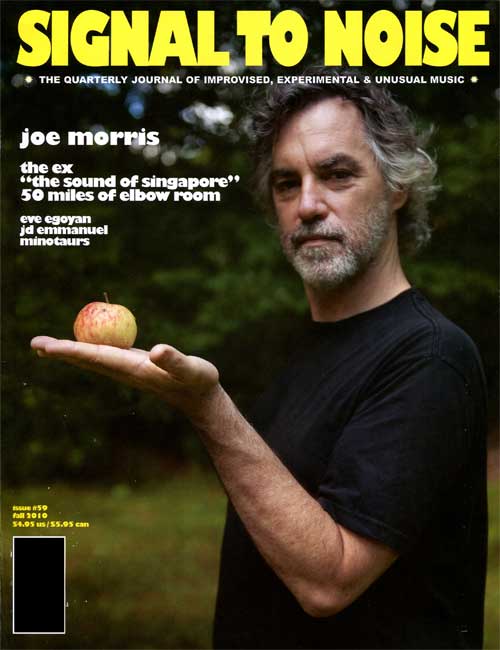
Monday, July 19, 2010
THE SOLITARY AGONY OF THE LIT-FIC WRITER (OR, FIRST WORLD PROBLEMS, FICTION DIVISION)
This Slate.com essay is the latest variant of something I've read over and over the past few years—the "woe is me" cry of the literary fiction writer. This woman wrote a novel, Stiltsville , which will be published by Harper Collins on August 1. Here's the synopsis, from Amazon:
That sounds like a book I'd rather stab my eyes out than read. Hell, that sounds like a book that would make my 61-year-old mother laugh in my face, if I offered it to her. And yet, this woman spent ten years grinding away, compelled to tell the story of a woman and her goddamn stilt house in Florida.
I've read these piteous cries from writers of "quality" lit-fic for years, talking about how they've slaved over their postmodern tales of suburban marital dissolution, or young men coming to grips with the adult world outside the room where they keep all their comic books, or whatever the fuck it is...and then I look at authors I read, like Scott Sigler, or Harlan Coben, or Stephen King—dudes who crank out a book a year and never shed a single public tear in the process. And it makes me think that maybe the reason literary fiction takes so long, and takes so much out of its writers, is that it's every bit as boring to write as it is to read.
(As far as the whole non-productivity thing, I can't quite take the essayist/author's side on that one, either. I have ideas for novels that never get off the ground, but it's not because I'm blocked or agonizing over the creative process—it's because I'm too busy writing other stuff. I've probably written hundreds of thousands of words this year, but they're subdivided into 200-words-or-less increments for All Music Guide, Alternative Press, the Cleveland Scene, The Wire, etc., etc. When I write a thousand words or more at a shot, they tend to be for a magazine feature. I'd love to have enough hours in the day to sit down and crank out a novel, but I write about a half dozen record reviews a week, on average, and maintain two blogs—this one and this one. Hell, just writing this blog post is taking me away from a magazine profile of Joe Morris that I should be working on.)
, which will be published by Harper Collins on August 1. Here's the synopsis, from Amazon:With its lush flora and constant sun, South Florida is the true star of Daniel's exquisite debut, which follows a marriage over the course of 30 years. In 1969, having traveled from Atlanta to Miami for a college friend's wedding, 26-year-old Frances Ellerby meets glamorous Miami native Marse Heiger, who introduces her to Dennis DuVals and his house on stilts in Biscayne Bay. Though Marse has set her cap for Dennis, he and Frances fall in love and marry within a year. "I had no idea then," Frances says, "what would happen to my love, what nourishment it would receive, how mighty it would grow." Dennis and Frances have a daughter, Margo, buy a house in Coral Gables, and their life together proceeds as a series of ups and downs, beautifully told from Frances's pensive, sharp perspective. As the years pass and Miami changes, so do Frances, Dennis, and Margo, and the nuances of their relationships shift and realign, drawing inexorably toward a moving resolution.
That sounds like a book I'd rather stab my eyes out than read. Hell, that sounds like a book that would make my 61-year-old mother laugh in my face, if I offered it to her. And yet, this woman spent ten years grinding away, compelled to tell the story of a woman and her goddamn stilt house in Florida.
I've read these piteous cries from writers of "quality" lit-fic for years, talking about how they've slaved over their postmodern tales of suburban marital dissolution, or young men coming to grips with the adult world outside the room where they keep all their comic books, or whatever the fuck it is...and then I look at authors I read, like Scott Sigler, or Harlan Coben, or Stephen King—dudes who crank out a book a year and never shed a single public tear in the process. And it makes me think that maybe the reason literary fiction takes so long, and takes so much out of its writers, is that it's every bit as boring to write as it is to read.
(As far as the whole non-productivity thing, I can't quite take the essayist/author's side on that one, either. I have ideas for novels that never get off the ground, but it's not because I'm blocked or agonizing over the creative process—it's because I'm too busy writing other stuff. I've probably written hundreds of thousands of words this year, but they're subdivided into 200-words-or-less increments for All Music Guide, Alternative Press, the Cleveland Scene, The Wire, etc., etc. When I write a thousand words or more at a shot, they tend to be for a magazine feature. I'd love to have enough hours in the day to sit down and crank out a novel, but I write about a half dozen record reviews a week, on average, and maintain two blogs—this one and this one. Hell, just writing this blog post is taking me away from a magazine profile of Joe Morris that I should be working on.)
Sunday, June 20, 2010
STEPHEN HAYNES, "PARRHESIA"

Stephen Haynes is a trumpeter and longtime student of/collaborator with the late Bill Dixon. He can be heard on several Dixon albums, including In Italy Vol. 1
 and Vol. 2
 , 17 Musicians in Search of a Sound: Darfur
 and Tapestries for Small Orchestra
 . He also recorded a 2008 double trio album with Taylor Ho Bynum, which I reviewed for The Wire.
Parrhesia
 , which comes out on Tuesday, is his debut as a leader; the disc also features Joe Morris on guitar and Warren Smith on drums, percussion and vibes. It's a sparse and abstract disc, full of smeared horn phrases, sudden rattles, lots of space between bursts of sound, and micro-melodies that never resolve into traditional song form. Haynes and Morris don't dialogue much, but they always seem to be listening to each other and thinking very carefully about what they play and why. Perhaps even more importantly (from my point of view, anyhow), Smith (who recites a poem on the sixth track, "Yet and Still"—you've been warned) plays the drums in a fully engaged way, avoiding the diffident brushed-cymbals-and-tiny-gongs approach that makes so much capital-I improv the ideal soundtrack to a nap.
Haynes is a friend and collaborator (he wrote a terrific session diary about Tapestries for Small Orchestra, including observations from some of the other musicians present, for Burning Ambulance). But even if he was a total stranger to me, I'd say you should definitely check this disc out.
Subscribe to:
Posts (Atom)